Twisted Tealms
The project
Defeat monsters, collect items, and strengthen your characters to prevail in a battle for the future of the world against the Omen and its followers. Each player takes on the role of a hunter to infiltrate the castle at the centre of the game and defeat the Omen once and for all. Fight your way through procedurally generated battlegrounds against both evil forces and your competitors, claiming all the glory (and gold) for yourself. But beware: if your internal power struggle lasts too long, it could mean the end for this world.
Originally developed as a classic board game during the first semester of the Media Informatics program, three of the original members have now come together to digitize the project, adding revisions and previously unimplemented mechanics to the original concept with their newly acquired skills. Development and conceptualization have been ongoing for four months now, with a planned release on Steam and other platforms.
My role
My roles within the team primarily consist of game design and the role of Technical Lead. As a game designer, my initial task was to update the outdated game design document to our current knowledge in the game development process. Even in the original version of the game concept, some weaknesses were identified through playtests and feedback from our supervisors, but due to time constraints or lack of know-how, they were never addressed until completion. Using old notes and records, numerous mechanics, particularly related to the combat system, were overhauled to create a much more cohesive overall picture.
In the second step, as Technical Lead, it is now my responsibility to implement previously defined game mechanics in the engine. Since this project is an opportunity for all of us on the team to learn and expand our skills, we chose the Unreal Engine for implementation, with which I personally had limited experience until then.
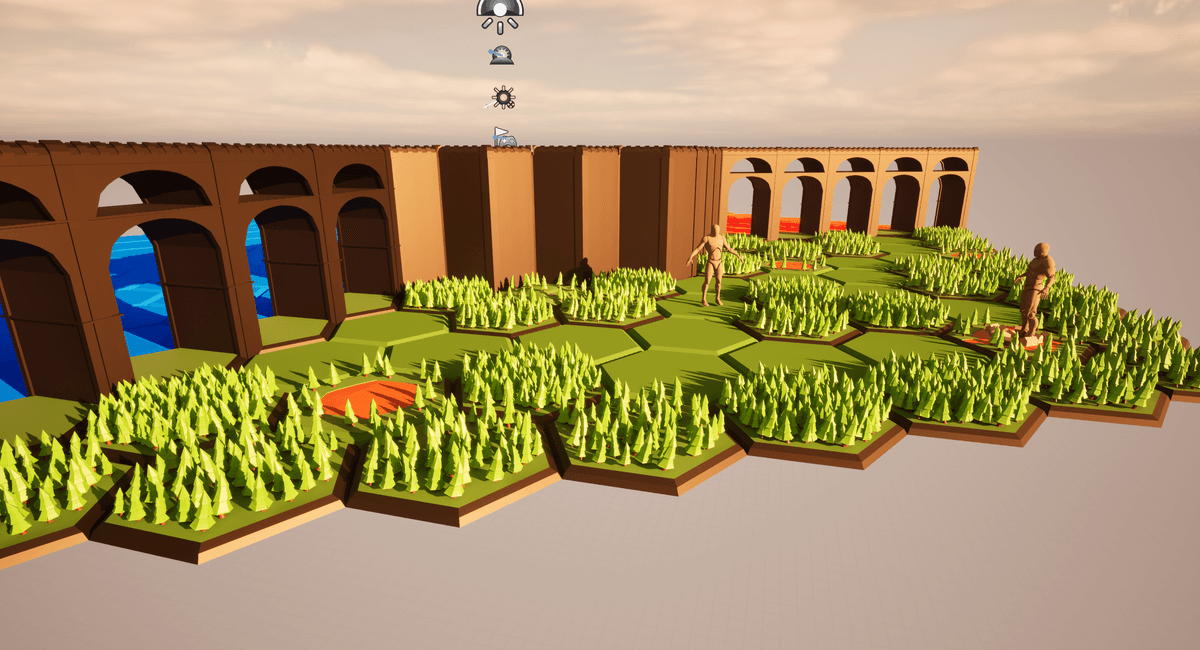
The majority of my technical work involves grid-based character movements and procedural generation of the game field. While square game fields are much more intuitive in their handling, hexagons bring a new depth with a variety of mathematical peculiarities, all of which add a new layer of complexity. A new coordinate system, distance calculations across diagonals, or conversions between field coordinates and room coordinates are just a few key points. Additionally, field generation serves as both an adoption of the modular structure of the original concept and a personal challenge for myself, as procedural generation in games has interested me for some time.
Learned Skills
- Identifying and addressing issues in existing game concepts
- Independent work and organization within a team
- Structured documentation and dissemination of work results
- Engaging in reasoned discussions of solution approaches within a team
- Game development in the Unreal Engine
- Development of procedural generation algorithms and balancing them
Download the Game Design Document here (German only).