domeba
The project
Based in the german city of Chemnitz, domeba focuses on providing their customers with software solutions on the fields of legal compliance, human resources and safety regulations. Starting out with a tiny team their solutions have stood the test of time and by now their services are used by companies like Coca Cola, Unilever or AEG. Their flagship software iManSys allows partners to keep track of regular examinations or changes in laws and regulations but also offers them a direct connection to legal consulting partners.
domeba itself is only the developer of said tools and still requires external legal consulting partners to work together with each potential customer to figure out relevant regulations and first set up their individual version of the iManSys software. To become more independent from such partners and also potentially offer a more broadly available version of their software they now want to expand into the branch of legal consulting. By building a massive database of international laws and regulations neatly organized and categorized, the goal is for future partners not to be required to take part in an extensive legal consulting but instead just take a basic survey about their company's situation. This new enhanced version of iManSys then takes said input to search the entire database for every legal document that would concern the company and offer them a simple guideline on all regulations that are required of them.
My role
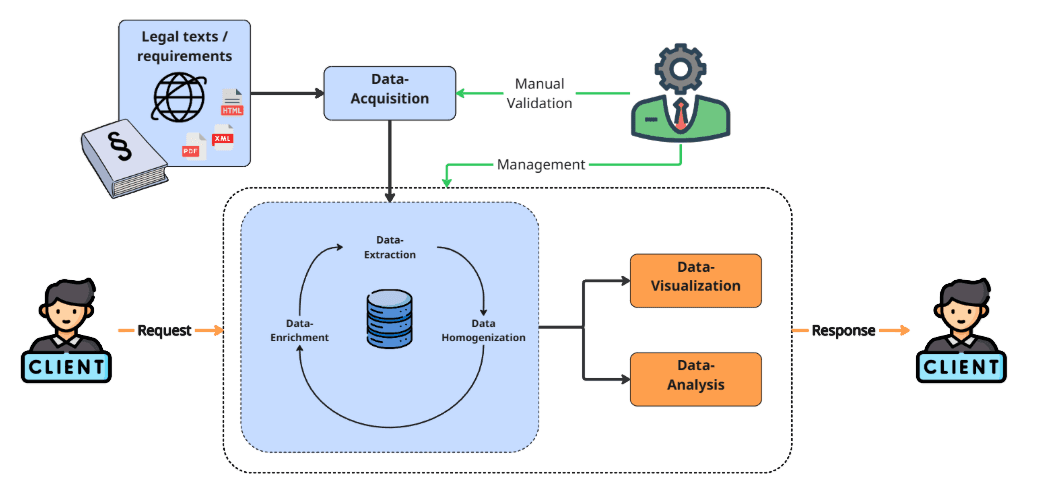
With the first weeks spent on coming up with an overall goal for our collaboration and transferring the rough idea of data collection and processing into an actual programmatic flow, we decided to split the entire workflow into four different parts that would each be worked on by a smaller subgroup of our student team: acquisition, extraction, homogenization and visualization. As our results are directly taken over by domeba after project completion we had to follow their already used internal tech stack consisting of AngularJS, .NET Core with Entity Framework and the Azure DevOps Tools for organization and code tracking.
With my previous experience with .NET and C# in general I became team lead of the extraction step and was tasked with creating a way to extract programmatically usable data from legal texts offered by different providers in various formattings and data formats. While structured formats like HTML, XML or JSON could be worked with comparably easy because of existing libraries, the complex challenge lied in retrieving structured data from PDF files. Recognizing headings, deciding which blocks of text were part of the same structural unit and even extracting text from embedded images in an ordered manner were all just a few parts of what made working with the PDF format so difficult.
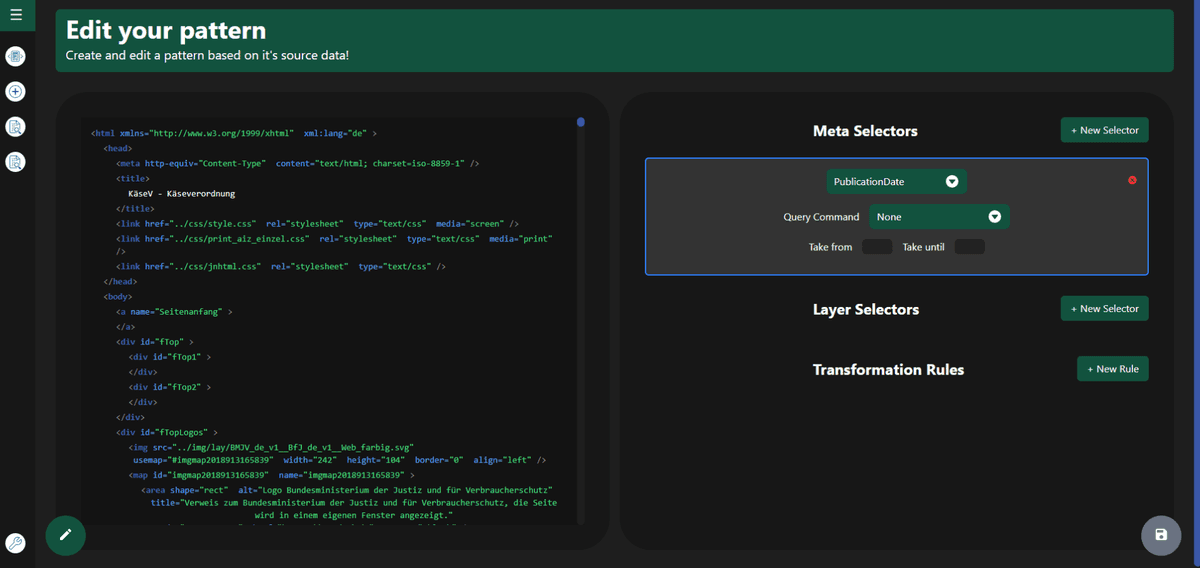
In regards to the user experience of the persons tasked with overseeing the collection process from within domeba we designed a system of reusable patterns so that extraction settings can be shared across multiple documents from the same source following a similar structure. To make the creation process behind these patterns as easily accessible as possible I also helped out in the visualization department to create the entire frontend interface for the pattern editor, giving users a visual depiction of what each rule will do on the given example document and allowing for test-parses to inspect the output for potential errors and making adjustments within the patterns.
With the extraction logic for structured data formats done, I split off from the rest of team that continued work on the parsing of PDF files went over to the next phase - data enrichment. With the goal of a fully automated recommendation system in mind all of the legal documents stored inside the database would need some sort of categorization as just a basic fulltext search would always leave room for missing documents without an exact word for word match. After consulting with one of domeba's lawyers about what they would desire from the software solution we were designing, we settled on a basic labeling system to categorize texts by their type, origin, legal field and topic. To keep this labeling process fully automated, I was tasked with conceptualizing and implementing a Machine Learning approach with ML.NET that would analyze each document on a multitude of parameters (keywords, sentence structure, word frequency...). Those analyzation results are then fed into a multiclass prediction algorithm calculating a probability for each label and automatically assigning it if a threshold is crossed.
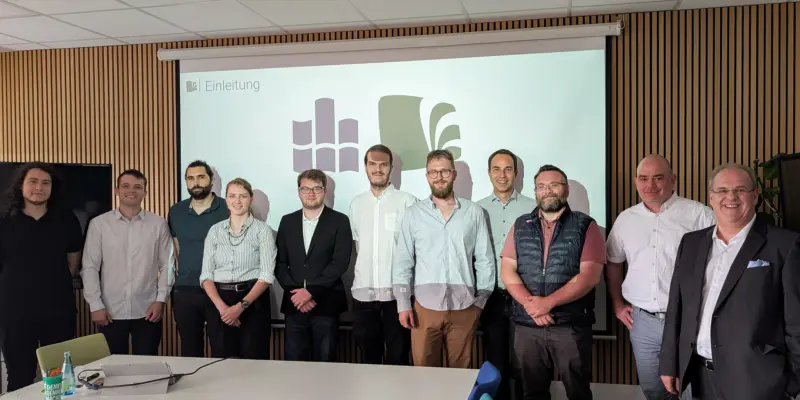
We presented our results in front of multiple company representatives including domeba's CEO Matthias Domes,. Closing our collaboration off with discussions about potentials for future development directions we received strongly positive feedback for our achievements with Mr. Domes even saying "What has been created here has real potential".
Learned Skills
- Structured planning of a software solution based on stakeholder and user requirements
- Organization within a team of over 10 people
- Leading a team, organizing tasks and reviewing results from different members
- Advanced coding paradigms within the .NET Framework and in API design
- First experiences with Machine Learning using ML.NET
- Working inside a production-grade code management cycle with task creation, review cycles and security measurements
- Regularly presenting the current state of production and defending design decisions in front of stakeholders
- Working with a multitude of third-party libraries and acquiring knowledge about their implementation and use
The official press release about this collaboration can be found on domeba's homepage.